Cwm Colliery: The Story of the Mine That Helped Shape Our Community

The remarkable story of one of the area’s biggest industrial landmarks, the thousands of men who worked beneath our feet, and the industry that helped shape the communities of Llantwit Fardre, Beddau, Tonteg and Church Village.
For generations, the landscape around Llantwit Fardre was dominated by an industry that shaped almost every aspect of local life. Coal mining wasn’t simply a source of employment. It influenced where people lived, how families survived, where communities grew and the identity of the villages we know today.
One of the most significant industrial landmarks in our area’s history was Cwm Colliery, situated at Beddau. At its height, the Cwm and Coedely mining complex employed well over a thousand people and was among the major industrial operations in the South Wales coalfield.
Today, much of that industrial landscape has disappeared or been transformed. But its legacy remains an important part of our local history.
The beginning: Digging deep beneath Beddau
The story of Cwm Colliery began in 1909, when work started on sinking the shafts. Coal production did not actually begin until 1914, when the mine began operating through two deep shafts known as Margaret and Mildred.
These shafts extended more than 750 yards underground, taking miners deep beneath the South Wales landscape in search of valuable coal seams. The mine quickly became an important source of employment for the surrounding communities.
In 1928, Cwm was taken over by Powell Duffryn Associated Collieries, one of the major coal-owning companies in South Wales. By this stage, more than 1,000 men were employed at the colliery.
For families in Beddau, Llantwit Fardre and the surrounding villages, the mine represented a vital source of income and an important part of everyday life.
A giant of the South Wales coalfield
The nationalisation of Britain’s coal industry in 1947 brought Cwm Colliery under the control of the newly established National Coal Board.
What followed was a major period of investment and redevelopment. Between 1952 and 1960, approximately £9 million was spent modernising the operation.
One of the most significant developments was the underground connection between Cwm and Coedely Colliery, more than five kilometres away towards Tonyrefail. This effectively brought the two operations together as one enormous mining complex.
By the 1960s and 1970s, the combined operation had become a major employer in the area. During the 1970s, the complex produced approximately 515,000 tonnes of steam coal annually and employed around 1,580 men.
These were extraordinary figures and demonstrate just how important the mining industry was to the local economy.

Cwm Coke Works: Another major local employer
Coal mining was only part of the story. Alongside the colliery, a major industrial facility known as Cwm Coke Works was developed.
Opening in 1958, the works processed coal to produce coke, an essential material used in industrial processes, including iron and steel production. The facility also produced other by-products, including gas, tar and ammonium sulphate.
The coke works became another significant local employer. Its industrial landscape, including its distinctive structures and gas holders, became a familiar sight for generations of people living nearby.
Even after Cwm Colliery closed in 1986, the coke works continued operating, bringing in coal from other sources. However, the changing economics of the industry and the need for substantial modernisation eventually caught up with the site.
The coke works finally closed in the early 2000s, bringing an end to an extraordinary chapter of industrial activity in the area.
The end of an era
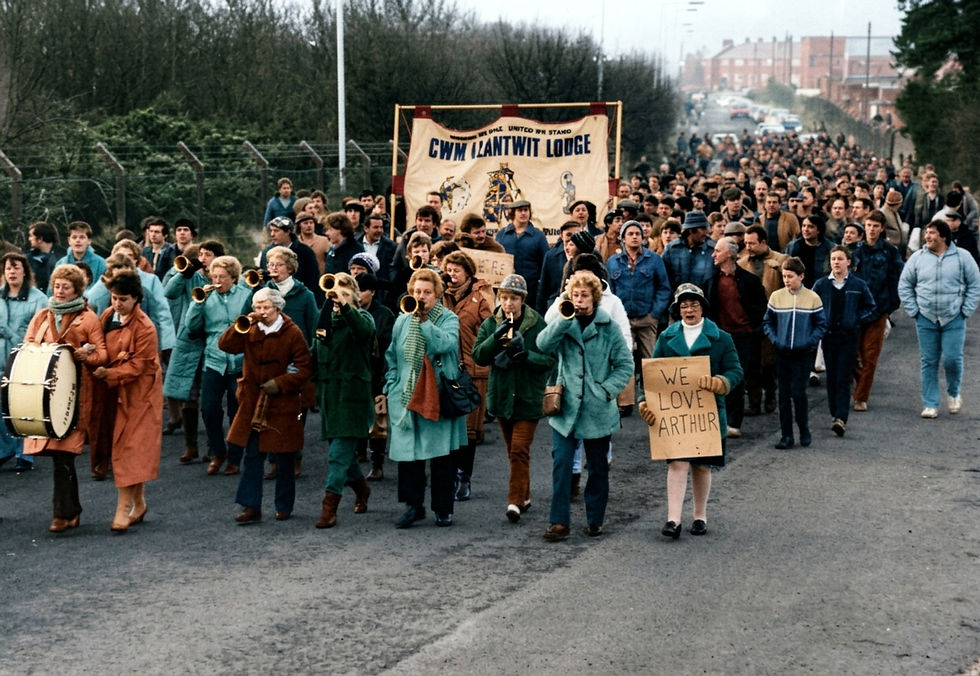
By the 1980s, the British coal industry was facing enormous economic and political challenges. The miners’ strike of 1984–85 had a profound impact on mining communities throughout South Wales.
Cwm Colliery eventually closed on 28 November 1986. For the men who worked there, and the families who depended on the mine, the closure marked the end of an era.
The loss of mining employment had consequences that extended far beyond the pit itself. Local businesses, shops, pubs and other services had all benefited from the wages and spending power of the mining workforce.
The closure was therefore not simply the loss of an industrial operation. It represented a major change in the social and economic life of the surrounding communities.
What remains today?
The landscape around Beddau and the former colliery site has changed enormously. The winding structures, machinery and buildings that once dominated the area are largely gone.
Yet the story of Cwm Colliery remains part of the identity of this community. Many local families have direct connections to the mine. Fathers, grandfathers, brothers, uncles and neighbours spent years working underground or at the surface.
For younger generations, the scale of the operation and the number of people employed there may be difficult to imagine. But it is important that these stories are not lost.
The history of Cwm Colliery is not just about coal production, machinery and industrial statistics. It is about the people who worked there, the families they supported and the community they helped build.

Do you remember Cwm Colliery?
We’d love to hear from anyone who has memories or family connections to Cwm Colliery or the old Cwm Coke Works.
Perhaps you worked at the colliery, remember a family member who did, or grew up watching the industrial landscape change.
Do you have any old photographs of the pit, the coke works, the miners or the surrounding area?
Share your memories and photographs with LlantwitFardre.com. Let’s preserve the stories of the people and industries that helped make our community what it is today.
I believe that my grandfather was one of the team who drove the shafts and headings of the Cwm Colliery. His name Reg John